Common Uses & Strengths
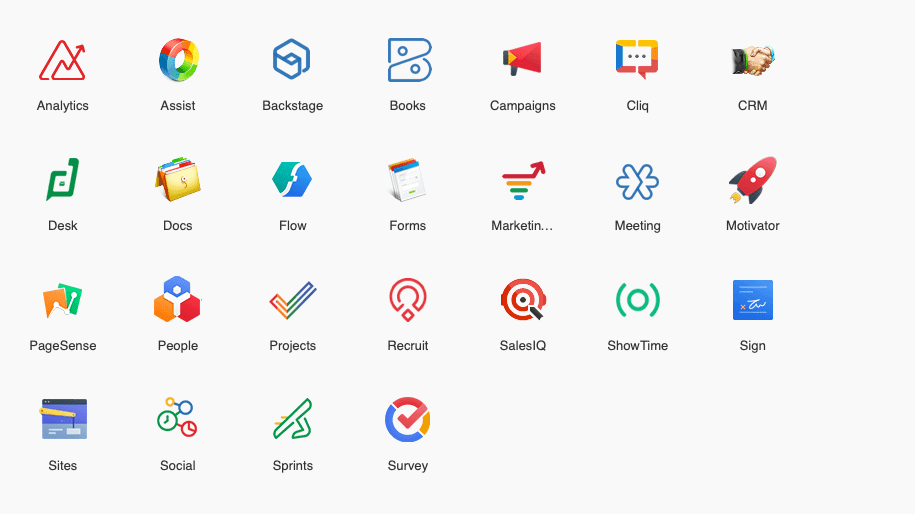
- What it does well: Offers a unified platform of applications that work together, reducing the need for multiple vendors.
- What it’s known for: Strong value-pricing, flexibility for SMBs, broad feature set across CRM, finance, HR, operations.
- Functions it supports: Lead and deal management, order-to-cash, accounting/bookkeeping, HR/people management, project tracking, analytics/reporting, collaboration.
- What it optimizes and automates: Sales workflows, customer service operations, financial processing, employee onboarding and operations, data centralization.
- Reasons people trust it: Platform coherence, strong global user base, continuous enhancement of modules (such as AI assistant “Zia”), and support for wide industry adoption.
- Other benefits / competitive wins: Often chosen by businesses moving from more expensive platforms for cost efficiency and scalability; strong mobile and remote-access support.
Key Considerations
- Considerations when buying: While highly featured, full benefit often depends on deploying multiple apps and integrating them, which can raise cost and complexity; licensing and module strategy matter.
- Considerations when implementing: Requires planning for change management, user training, data migration, and module configuration to align with business processes.
- Stickiness and training complexity: Because the suite covers many modules, onboarding may be steeper for teams unfamiliar with end-to-end systems; modular roll-out strategy typically helps.
- Integration methods and common integrations: Integrates via APIs, custom connectors, and built-in extensions; common integrations include Google Workspace, Microsoft 365, external ERP/legacy systems, e-commerce and payment gateways.
- How to expand on the solution: Start with core modules (CRM or finance) and incrementally add operations, HR, analytics; leverage the unified stack to centralize data and build dashboards across functions.
Common Needs & Challenges
- Weaknesses: The breadth of modules means some components may not match best-in-class niche solutions; standard configuration may require significant tailoring for complex industries.
- Key complaints: Users may cite steep learning curve, overlapping module features, sometimes slower support responses for highly customized implementations.
- Common gaps and shortcomings: Deep legacy system migration, highly-customized integrations, industry-specific regulatory modules may require additional development.
- Things requiring most assistance: Legacy data migration into Zoho Books or CRM, building custom workflows, bespoke integrations with ERP/manufacturing systems, custom analytics and reporting dashboards.
- Common integrations: Migration from legacy ERPs, linking CRM to ERP/finance, connecting Zoho Books with warehouse/inventory systems, exposing data into BI tools (Zoho Analytics or external).
- Security and privacy overview: Zoho emphasizes data-privacy (GDPR-compliance, strong global infrastructure) and SaaS security standards; however organizations still need to validate controls for their specific region, vertical and data-sensitivity